
That are insanely interesting
Life was tough for the Greek commonfolk in the ancient times.
Imagine being the first person in history to be sentenced to eternal torture. Or being cursed with a hunger so intense that you end up devouring yourself.
Greek mythology is full of famous stories about the gods, the Trojan war and the labours of Hercules. But some of the most fascinating myths, known as strange Greek myths, lie far away from those well-known tales.
Here are seven strange Greek myths from the fringes of Olympus.
Watch the video below where I discuss more about the first six.
Table of Contents
#1 Tiresias, The Androgynous Seer

Deep in the woods of Mount Kyllene (Cyllene), a young man once came across two snakes mating. Acting on impulse, he struck them with his staff.
Instantly, the gods transformed him into a woman.
That person was Tiresias, who would become one of the most famous prophets in Greek mythology. He lived as a woman for seven years before encountering the snakes again. This time he left them alone and was transformed back into a man.
Because of this strange experience, Tiresias became the only mortal who had lived as both man and woman.
So when Zeus and Hera once argued about who experiences more pleasure during love, men or women, they turned to Tiresias for the answer.
His reply was simple. Women experience nine times more pleasure.
Hera was furious and blinded him. Zeus could not undo the punishment, but he gave Tiresias the gift of prophecy and a long life.
Blind, yet able to see fate. Tiresias, the wise.
#2 Pygmalion and Galatea: A Love Story?

In ancient Cyprus lived Pygmalion, a master sculptor who had grown disillusioned with women. Convinced that real women were too flawed, he devoted himself to art.
He carved an ivory statue of a woman so perfect that it seemed alive. He dressed it, spoke to it, and eventually fell in love with it.
Later storytellers named the statue Galatea.
During a festival honoring Aphrodite, Pygmalion wished for a wife who looked exactly like his statue. The goddess granted his wish.
When he returned home and kissed the statue, the ivory softened and became flesh. Galatea came to life.
The story ends happily, but it leaves an unsettling question.
Did Galatea ever have a choice? In being brought to life or in being loved?
She simply awakens into a world where she is already loved. That too by a misogynist of the highest degree!
#3 Erysichthon, The Cannibal King

Erysichthon was a king who believed nature existed only to serve him.
One day he ordered his men to cut down a sacred tree in a grove dedicated to Demeter, the goddess of agriculture. He wanted the wood to build a grand banquet hall.
The tree cried out in pain. Demeter appeared in disguise and warned him to stop.
He laughed and threatened her.
Instead of striking him down, the goddess sent a curse. Endless hunger.
From that moment on, Erysichthon could never be satisfied. He devoured enormous feasts, yet only grew hungrier.
His wealth vanished, his possessions were sold, and even his daughter was traded away to feed his appetite.
Eventually nothing remained.
So Erysichthon began to eat himself, until he consumed himself completely. THE CANNIBAL KING
His story is a chilling warning about greed and the destruction of nature and its implications on humankind.
Are we already moving towards self-destruction like Erysichthon did?
Trivia – Erysichthon means ‘Tearing up Earth‘. Which is what he did by cutting down Demeter’s sacred tree.
#4 Atalanta, defied by her own obedience

Atalanta was one of the greatest huntresses in Greek mythology.
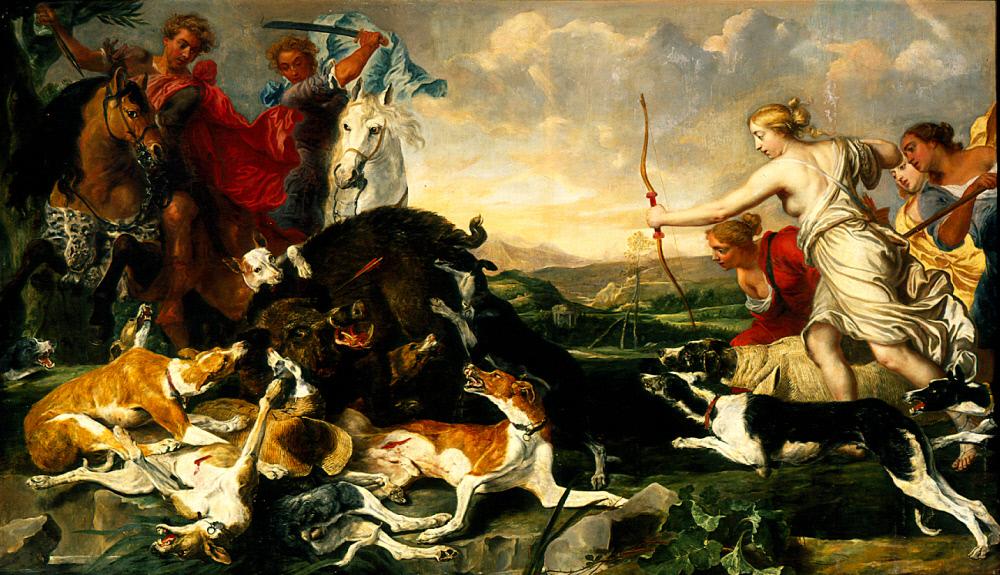
Abandoned at birth and raised by a she-bear, she grew into a warrior faster and more skilled than most men. She even joined the famous Calydonian Boar Hunt with the Hero Meleager and was the first to wound the beast.
But Atalanta had made a vow to Artemis that she would remain unmarried.
To keep her freedom, she declared that she would only marry a man who could defeat her in a footrace. An impossible task.
No one succeeded until Hippomenes.
With help from Aphrodite, he dropped three golden apples during the race. Each time, Atalanta paused to pick one up, slowing just enough to lose.
She married him, but their story did not end well.
After Hippomenes forgot to thank Aphrodite for help with Atalanta, the goddess cursed them with uncontrollable passion. They made love in a temple of Zeus (or Rhea in some accounts) and for this sacrilege, were transformed into lions.
Atalanta did everything right, yet still lost the freedom she fought for.
Why are all these stories turning out to be sad? Not sure, but the next one takes the cake.
#5 Meleager: The Hero Whose Life Was Tied to a Log

Meleager, another hero of the Calydonian Boar Hunt, was born under a strange prophecy.
The Fates declared that his life would last only as long as a single wooden log remained unburned.
Terrified, his mother Althaea hid the log.
Years later, Meleager led the hunt for the monstrous boar sent by Artemis, joined by Atalanta who was the first to wound the beast.
After the beast was slain, he honored Atalanta by awarding her the trophy (rightfully!).
This angered his uncles, who believed a woman deserved no such prize. In the fight that followed, Meleager killed them.
When Althaea (Meleager’s mother) learned that her brothers were dead, grief overcame love.
She took the hidden log and threw it into the fire!
As the wood burned, Meleager’s life faded with it.
Not sure what this story teaches or what questions should be asked, but this one is interestingly sad and could be converted into an HBO miniseries. Just my two cents.
#6 Ixion: The First Eternal Punishment

Ixion committed one of the worst crimes in the ancient world. He violated xenia, the sacred law of hospitality.
Despite his past crimes of killing his father-in-law, Zeus showed him mercy and welcomed him to Mount Olympus.
No one knows why Zeus showed mercy to a criminal, but then Zeus wasn’t exactly known to be doing things logically.
Ixion repaid that kindness by attempting to seduce Hera.
To test him, Zeus created a cloud shaped like Hera. Ixion fell for the illusion and revealed his intentions.
This time Zeus showed no mercy.
Ixion was bound to a fiery spinning wheel and cast into Tartarus, where it would turn forever.
He became the first mortal in Greek mythology to suffer eternal punishment.
And is possibly being roasted as we speak.
#7 Bonus – The Procrustean Bed

On a lonely road near Athens lived a bandit named Procrustes.
He welcomed travelers into his home and offered them a free bed for the night.
But the bed had a rule.
If a guest was too tall, Procrustes cut off their legs. If they were too short, he stretched them until they fit.
The bed never changed. Only the people did.
One day the hero Theseus arrived. Yea, the same guy who killed the Minotaur.
When Procrustes tried the same trick, Theseus forced him onto the bed instead. More like tricked him.
So Theseus fit the bed perfectly (Yea, Deus Ex Machina)
He then asked Procrustes to test his own bed indicating him that the bed was flawed.
Procrustes did not fit.
And he suffered the same fate he had given others.
Greek myths often tell stories about heroes defeating monsters. But Procrustes was not a creature with claws or fangs.
He was something far more familiar. (Inner Demon awakes!)
A reminder of what happens when people are forced to fit a system that was never meant for them.
Trivia – Procrustes was Poseidon’s son
So, which one is your favourite? Tell me in the comments!
If you enjoy strange mythology stories, you may also like my article on The Judgement of Paris, the worst decision made in Greek Mythology.
One response to “Obscure Greek Myths”
[…] if you found this post interesting, you might enjoy the other posts like this or this from Greek Mythology companion video on the Madame Curieus YouTube […]