
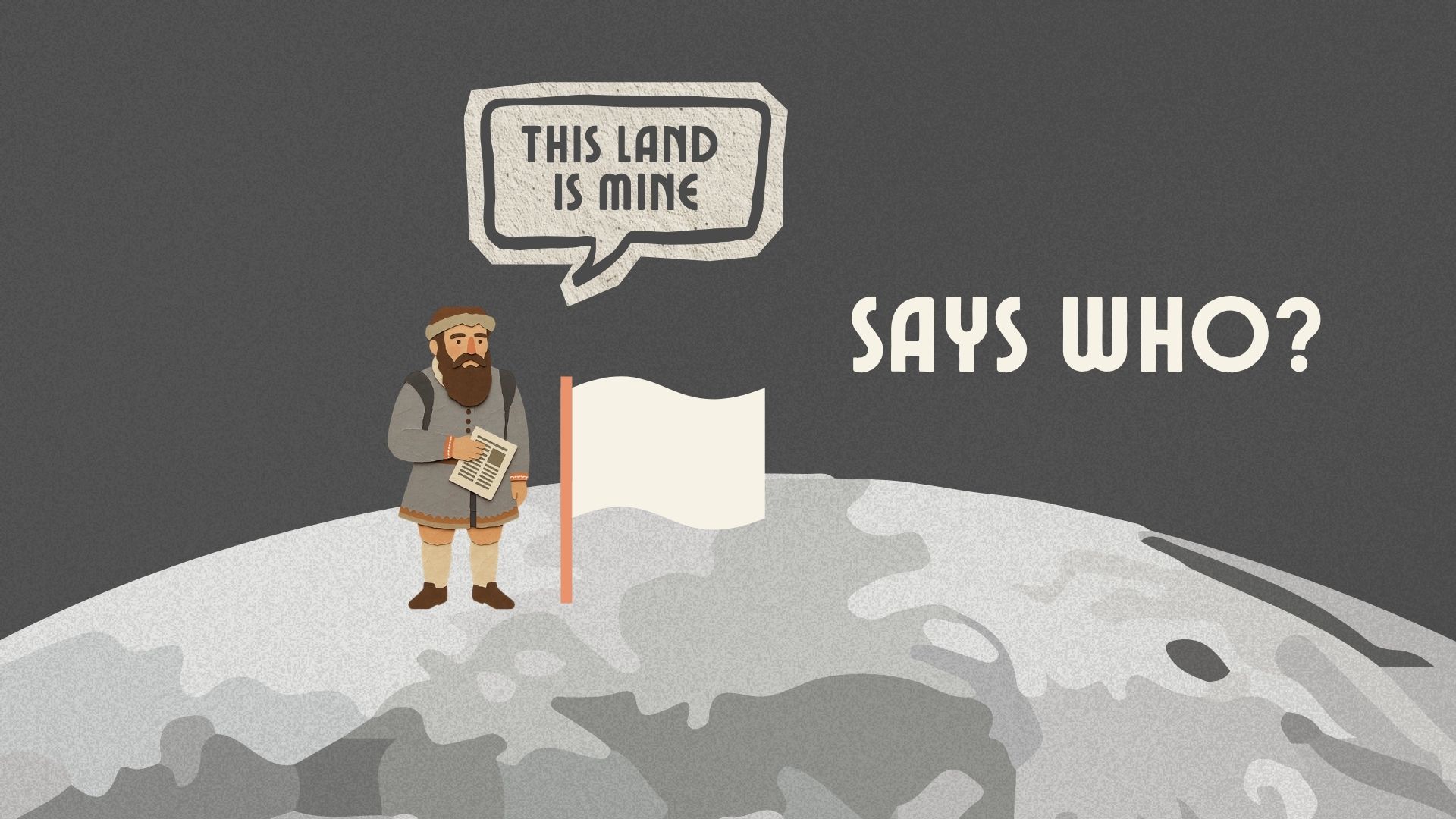
This is Jenaro Gajardo Vera, the first ever recorded person to claim ownership of the Moon in 1954.

Then, in 1996, a German man named Martin Juergens declared that ownership of the Moon had been transferred to him through succession, claiming it had been granted to his ancestors in 1756 by Prussian King Frederick the Great as a reward for their service.

But the most famous Moon claimant is Dennis Hope.
In 1982, he even created an extraterrestrial real estate company called the Lunar Embassy, where he claims to have sold millions of acres of lunar land.
Some of the famous owners include ex-US President Barack Obama, celebrities like Tom Cruise, Nicole Kidman & Shahrukh Khan.

So, who owns the Moon, really?
And can you actually buy a piece of this beautiful celestial body yourself?
Let’s find out. Watch the video below to skip the post
What Does “Owning” the Moon Even Mean?
On Earth, owning land means you have the legal right to use it, develop it, sell it, and stop others from trespassing.
Governments enforce those rights and courts back them up.
But the Moon? There’s no government up there. No police force. No courthouse.
So even if someone did own it, who’s going to enforce that?

This is the core problem. Ownership without enforcement is just a piece of paper. Or in Dennis Hope’s case, a very profitable piece of paper.
The Outer Space Treaty
So what does the actual law say?
In 1967, at the height of the Space Race, the UN put together the Outer Space Treaty, signed by over 100 nations.
Article II states clearly: no sovereignty, no occupation, no appropriation by any means.
No country can own the Moon.

But here’s the loophole that’s been driving lawyers and billionaires crazy ever since.
The treaty says ‘Nations’ can’t own the Moon.
It says nothing explicitly about private individuals or corporations.
That’s the gap Dennis Hope exploited.
His argument? “The treaty bans governments. I’m not a government.”
Legal scholars disagree. And somewhere in that gap, he’s reportedly made millions.

The UN tried to close this loophole with the Moon Agreement of 1979, which declared the Moon’s resources the “common heritage of mankind,” meaning no private exploitation allowed.
Here’s the problem.
No major spacefaring nation signed it. Not the US. Not Russia. Not China.
The countries that actually have rockets looked at this agreement and walked away.

The Artemis Accords: A New Rulebook
Fast forward to 2020. NASA introduced the Artemis Accords, and this is where the real action is.

The Accords explicitly state that countries and their commercial partners can extract and use lunar resources.
Not own the Moon, but take stuff from it.
Think of it like international waters. Nobody owns the ocean, but you can fish in it, drill it, and operate commercially on it.

Over 40 countries have signed, including India, Japan, and most of Europe.
China and Russia have not, launching their own rival lunar program instead.
The Moon has already become a geopolitical chessboard.
What’s Actually Up There?
Why does everyone suddenly care this much about the Moon? Two big reasons.
- Water Ice – NASA confirmed deposits of water ice in craters near the lunar poles. In space, water is rocket fuel. Split it into hydrogen and oxygen and you have propellant. The Moon could become a refuelling depot for missions to Mars and beyond, completely changing the economics of deep space exploration.

- Rare Earth Elements – The lunar surface holds essential rare earth minerals used in nearly all of the electronics we rely on daily. China controls over 60% of Earth’s rare earth production today, and lunar mining could completely reshape that leverage.

And then, the big one.
Helium-3: The Fuel of the Future
Helium-3 is the resource that has governments paying very close attention.
Nuclear fusion, the same process that powers the Sun, could generate vast amounts of clean energy.
Current fusion fuels produce high amounts of radioactive byproducts. Helium-3 based fusion produces far fewer, meaning cleaner, more efficient reactors.

On Earth, Helium-3 is extraordinarily rare. We measure it in kilograms.
On the Moon? Estimates suggest 1 to 5 million metric tonnes, deposited by solar wind over billions of years.
Scientists estimate that just 25 tonnes of fused Helium-3 could power the entire United States for a year.

Multiple entities are already mapping Helium-3 distribution on the lunar surface.
Whoever controls future access to this resource holds extraordinary energy leverage over the rest of the planet.
The Commercial Race
The commercial logic is simple.
If lunar resources are legally extractable, which the Artemis Accords are pushing toward, whoever builds infrastructure on the Moon first has a massive head start.
It is not unlike the early days of the internet.
The rules were vague. The frameworks were lagging.
The companies that moved fast built empires.
So, Can You Buy a Piece of the Moon?
You can hand Dennis Hope some money and receive a certificate. Thousands have done it.
But legally, it means nothing. No court, no country, no authority recognises it.
The Moon remains unowned. Based on where international law is heading, it will likely stay that way.
But resource extraction rights? Those are very much up for grabs.
The actual race, the one with rockets, billions of dollars, and geopolitical stakes, is only just beginning.
Nobody owns the Moon. But everybody wants a piece of it.

And honestly, given what’s up there, can you blame them?
If you liked this article, read our article on Fascinating Facts about the Apollo 11 Moon Landing OR How Moon Landing changed Everyday Lives